



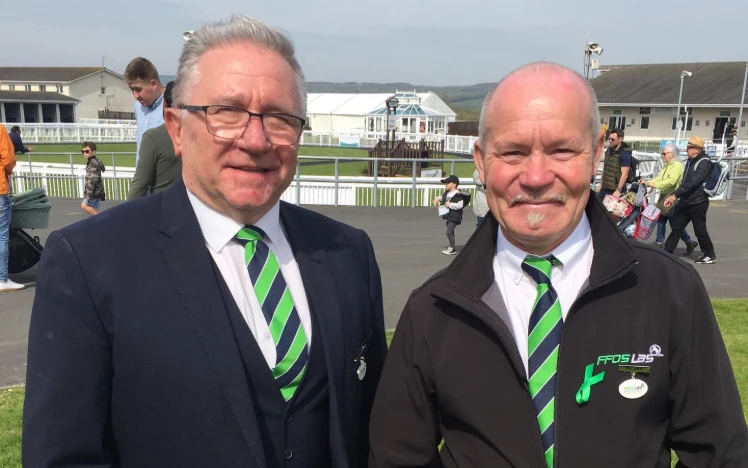
For as long as there has been horse racing at Ffos Las, there has been Phil “Tidds” Jones.
Sixteen years on from the Carmarthenshire track’s opening, Jones is not just the operations manager in title, but the living memory of the racecourse itself.
Fence attendant, doctor’s driver, flag operator, caretaker, site supervisor and now operations manager – there is scarcely a role at Ffos Las that he has not done.
It is why many around the place affectionately refer to him as “Mr Ffos Las”.
“I came here a month before it opened in 2009,” says Jones, who recently celebrated his landmark 300th race meeting at the racecourse near Trimsaran.
“I was lucky enough to be employed by Tim Long, who was the Clerk of the Course back then.”
Before racing entered his life professionally, Jones had already lived several working lives.
He left school at 16 to work in the steel industry, spending years at local steelworks and later with Dyfed Steels.
After that came 15 years with Carmarthenshire County Council as a ground maintenance operative, cutting grass across the county.
It was that job which first connected him to the land that would become Ffos Las.
“I was cutting grass all around, and I saw this place develop,” he recalls. “And I told my missus when I went home one day, ‘they’re building a racecourse in Trimsaran and I’m going to work there.’”
Few believed him. Fewer still believed the racecourse itself would last. Jones did.
“I always thought, if you’re building a racetrack near my house, I’m going to work there,” he says. “And that’s what I did.”
His first role was as a fence attendant – the on-the-spot safety role at any horse race meeting - a job he took on with relish as a lifelong racing fan.
Jones still laughs at choosing the final fence, the “glory fence” – while others hesitated. “Everybody laughed at me for that,” he says. “But I knew what I was doing.”
From there, his responsibilities grew. He became a driver for the racecourse doctors, spending nearly two years following the horses and jockeys around the track.
“I loved it. Absolutely loved it,” he says. “I’m here watching A.P. McCoy in front, and I’ve got two doctors in the back in case something goes wrong.”
Next came a stint as an advanced flag operator, learning the intricacies of race safety and false starts.
Then, when the caretaker retired, Jones was offered the chance to step into a permanent role on site.
Leaving the council was a leap of faith that shocked many.
“Everybody thought I was nuts,” he admits. “You’ve quit that good job to go down that racecourse. It probably won’t last two or three years.”
But Jones trusted his instincts – and his love of racing.
“I thought, no, this is a proper racecourse. It’s going to stay there.”
It did. And so did he.
Almost 17 years on, Ffos Las is still going strong and will host its first jumps meeting of 2026 on Friday, January 30.
Over time, Jones became the constant presence through waves of management change. General managers and operations managers came and went, but “Tidds” remained, quietly accumulating knowledge.
“I was the one to show them and put them through the ropes,” he explains.
“How big’s the course? How many fences are there? How many can we get in the restaurant? I happened to pick it all up over the years from one person to the next.”
That institutional knowledge is why, even before his official promotion last year, Jones was effectively doing the operations manager’s job.
“You come in, you’re the first one in, you’re the last one to leave,” he says. “If the fuse is blown, if the water’s not working, if it needs hoovering… you do everything that’s on this site, whether it’s big or small.”
He describes himself as “the glue”, filling the gaps between departments and making sure the racecourse functions smoothly on racedays and beyond.
His dedication is legendary. Jones missed just two meetings in his first 11 years – both due to holidays – and did not miss a single meeting for more than a decade until Covid intervened.
Since racing resumed, his attendance record has again been flawless.
“I’m local. I want to be here,” he says simply.
That commitment was tested most severely a couple of years ago on a Ladies’ Day that Jones still describes as his worst moment at Ffos Las.
With the busiest crowd of the year on site, the water supply suddenly failed.
“There’s no water on site,” he remembers. “You can’t race without water. That’s the first thing, I thought.”
After frantic checks, Jones discovered the main valve had been deliberately turned off.
“To this day, I think it was sabotage,” he says. “That hour, maybe an hour and a half, was so nerve-wracking. That’s the worst I’ve ever had here.”
Who – or why – anyone would want to wreck one particular race meeting remains a mystery.
Yet those moments also underline why Jones is indispensable. He knows where every pipe, fuse, and valve is. He knows how the place works because he has worked every corner of it.
Beyond racing, Jones has helped adapt Ffos Las for everything from fairs and circuses to SAS training exercises involving helicopters, armed units, and staged hostage scenarios.
Each time, he is involved from the planning stages, advising on access, drainage, and safety.
Still, what Jones values most is the people. Racing’s openness continues to amaze him.
“I still find it now really refreshing about racing,” he says. “You can just stand and talk to A.P. McCoy. Or Sean Bowen will stop and talk to you. You can’t do that in football or rugby.”
From steelworker to operations manager, from cutting grass to running a racecourse, Phil “Tids” Jones has grown alongside Ffos Las itself.
Sixteen years on, he remains its beating heart – the man who knows it better than anyone else, and the one everyone turns to when something needs fixing.